How to build a movement
Lessons from effective altruism and Christianity
When I attended my first effective altruism (EA) conference in 2022, I met some people who called themselves community builders. The job title struck me as strangely blunt, because it implies that community is something that can be bought and sold.
Though the job titles may have changed by now, the community building has worked. Since its founding in the early 2010s, EA has grown to over $1 billion in yearly grants, with substantial influence on the future of AI development, begging the question: what is it about effective altruism and its community builders that have made the movement so successful?
1. The perception of moral decline
In 2015, the essayist William Deresiewicz published a book called Excellent Sheep, haranguing elite colleges for churning out carbon-copied investment bankers and consultants motivated by nothing other than the search for prestige. Part of the problem, he argued, was that students were no longer engaging seriously with the liberal arts, and therefore lacked effective ways to understand the meaning of the human condition.
Deresiewicz turned out to be prescient, as the share of humanities majors continued to drop over the ensuing decade:

Students entering college between 2016 and 2022, myself included, thus arrived at a unique inflection point, in which the careerist majors conquered the university. Any perceptive teenager would have started to wonder — as Deresiewicz did — whether we were losing something important.
2. Arrival of a messianic message
I often wonder how the early Christians felt in the presence of Paul.1 Just imagine — you are poor, sick, and neglected, and the Roman Republic is in ruins, replaced by a decadent empire. What could be the meaning of all this suffering? Suddenly, Paul comes along and gives you the answer: sin is the condition of earthly life, and Jesus died for your sins, so that by believing in God and Jesus you, too, could find salvation from suffering.
Keep in mind that Jesus had just been crucified a couple decades earlier. Converting to Christianity in the days of Paul must have been an electrifying experience, because within a few hundred years, the entire Roman empire had declared itself Christian. A fitting modern analogy would be the entire city of New York becoming Knicks fans in the run-up to the 2026 NBA championship.
I joined my school's effective altruism club in my freshman year because I saw a picture of a famous tech founder on their table at the club fair. When I talked to the then-club president, she told me that the movement was dedicated to "doing the most good using evidence and reason," and I signed up then and there.
The tech founder on the flyer? Sam Bankman-Fried.
But that was before his crypto fraud case and the federal prison, and we were all looking for ideals to believe in. In a time of rampant careerism, when living a life of meaning seemed the least popular thing, I wanted to believe that Effective Altruism could make people care again. Eventually, I became an organizer, running reading groups and recruiting new members for the movement. What could be more important, I felt, than fighting the trend of moral decline that had captured our entire generation?
3. The movement absorbs its own critiques
There's a Kafka line that sums this up well:
Leopards break into the temple and drink all the sacrificial vessels dry; it keeps happening; in the end, it can be calculated in advance and is incorporated into the ritual.
As I learned more about Effective Altruism, I started questioning its priorities. Why, for example, should anyone prioritize shrimp welfare over climate change?
The most powerful part of the EA movement is its capacity for institutionalized self-criticism. Don't agree with what people are working on? Take your concerns to the EA forum, and you will find people arguing for both sides. For example, it turns out that there are plenty of good reasons to work on shrimp welfare, such as the fact that most shrimp nurseries still practice eyestalk ablation — literally cutting off or crushing the female shrimps' eye stalks — to speed up reproduction, but there are also many reasons that climate change may deserve more attention within EA. Knowing that reasonable people have debated the pros and cons on every issue makes it easier to accept that a given EA cause area is likely to be a good one.
Later on, I found out that Judaism has a tradition called the Talmud — a book in which Rabbis do a similar thing to the EA Forum and develop refutations to the arguments that might question the Jewish tradition. Perhaps the world's oldest FAQ, the Talmud provides answers to questions like how to spend to Sabbath, how to act with justice, and even why we exist. Strangely enough, the Forum covers similar ground, with topics like how to spend your time at a retreat, how to do the most good, and even what the metaphysical basis of morality might be.
Making critique a core part of your ideological system is a great way to ensure its staying power, regardless of its practical effects. It works for effective altruism, it works for Judaism, and it might even be working for democracy.
4. Building an enduring tradition
“-Ism's in my opinion are not good. A person should not believe in an -ism, he should believe in himself.”
— Ferris Bueller's Day Off (1986).
Around the year 1000, Christianity started to lose sight of the teachings of Jesus and Paul, and became increasingly corrupted by the legalism that early Christians had sought to escape. Over time, the increasingly dominant institution of the Church provided the perfect pretense for medieval priests to seek indulgences and for mobs to call people heretics and set them on fire.
Paul's contemporaries may have found it hard to believe that people would one day be reading treatises on the scale of Calvin and Thomas Aquinas, whose goal was to analyze scripture and form a logically consistent basis for Christianity. But without the electric energy of an Apostle — in a world where Christian love results in heretics burned at the stake — how could you keep the faith alive, other than through careful rationalization?
Because of its continual contradictions, successive Christian leaders, whether Pope Gregory VII, Martin Luther, or John Calvin, sought to reform the Church and reaffirm its ideological purity. Like Paul, they found clever ways to revive the relevance of Christian beliefs and keep the tradition alive, even as scientific evidence started to challenge its fundamental assumptions. Today, it's hard to imagine that the ideas of Christianity, and of Abrahamic religions in general, could ever truly disappear. The ideology and traditions have taken hold.
For effective altruism on college campuses, the appeal to rationality that made it so successful is also its weakness. When insecurities about moral decline ran high, a movement that explained why being a quant trader or computer programmer was a moral act was made to meet the moment. As that feeling started to subside, however — as the next generation comes to terms with a careerist status quo — the demand for moral salvation isn't quite what it used to be. But removing the messianic fervor from a movement may not be such a bad thing, if it enables those left behind to act with more clarity and perspective.
A Third Axial Age?
There is an oft-repeated quip that the history of Western philosophy consists of footnotes to Plato and Aristotle. One could argue, similarly, that the history of Chinese philosophy consists of footnotes to Confucius, Lao Tzu, and the Buddha. Each 5 of these figures lived and died within a few centuries of each other 2, begging the question of whether there was something special about the centuries in which they lived. In an attempt to capture the significance of this period, the centuries from 700 to 200 BCE are now termed the Axial Age.
Being a Roman Christian meant having uniquely high leverage. The same could be said for Chinese scholars of the Warring States period, or Greek scholars during the Golden Age of Greece. Since the decline of the Roman empire, there has not been a single political unit that could distribute a religious idea across all of Western civilization by fiat.
Just like the Cambrian Explosion allowed for a rapid expansion in new life forms, certain periods in history, such as the Axial Age and the Enlightenment, were uniquely generative. In typical eras, ideas change gradually as they interact and recombine. In pivotal eras, the external pressures on ideas accumulate and lead to a sea change. If enough of these forces coincide, our present day may become known as another pivotal era in history: a Third Axial Age.
In America, for instance, even as the overall proportion of Christians has held steady at around 62%, a much lower share of young Americans identify as Christian, indicating a coming decline:

As this gap grows, the question becomes where Americans, especially young Americans, will seek out spirituality. Will it be movements like effective altruism that seek out new definitions of virtue? Or is the belief in the supernatural merely a passing artifact of religious belief, soon to be dropped in a capitalism-obsessed world? My bet is that spirituality is here to stay. Over 90% of Americans believe in the existence of a supernatural soul or spirit:
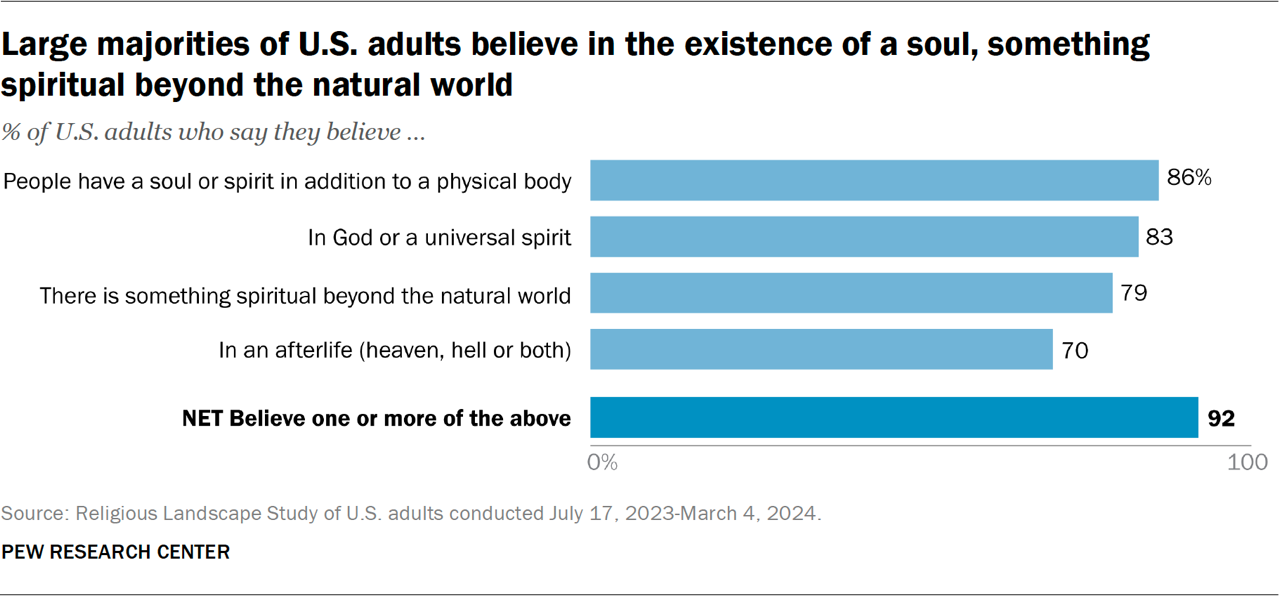
It is in this spiritual gap that new philosophies have started exploring ways to find virtue and transcendence. Besides Effective Altruism, there is progress studies, which is primarily a scientific effort but can be placed within the broader philosophy of Abundance. Closely related is the techno-optimist manifesto, which states that "everything good is downstream of growth". On the personal level, authors like Sam Harris argue for spirituality without religion, via the careful training of one's attention. For all their faults, this wave of new movements gesture at the start of a new collective story for humanity, centered around truth seeking, individual agency, and the relentless pursuit of progress.
If history is any guide, the perceived moral decline that pervades the zeitgeist — whether it's the decline of religiosity, the breakdown of Pax Americana, or the threat of transformative AI — also creates the conditions for a movement to reframe that anxiety into a vision for salvation. We have the chance to craft the story of our own Axial Age. Let's make it an optimistic one.